

























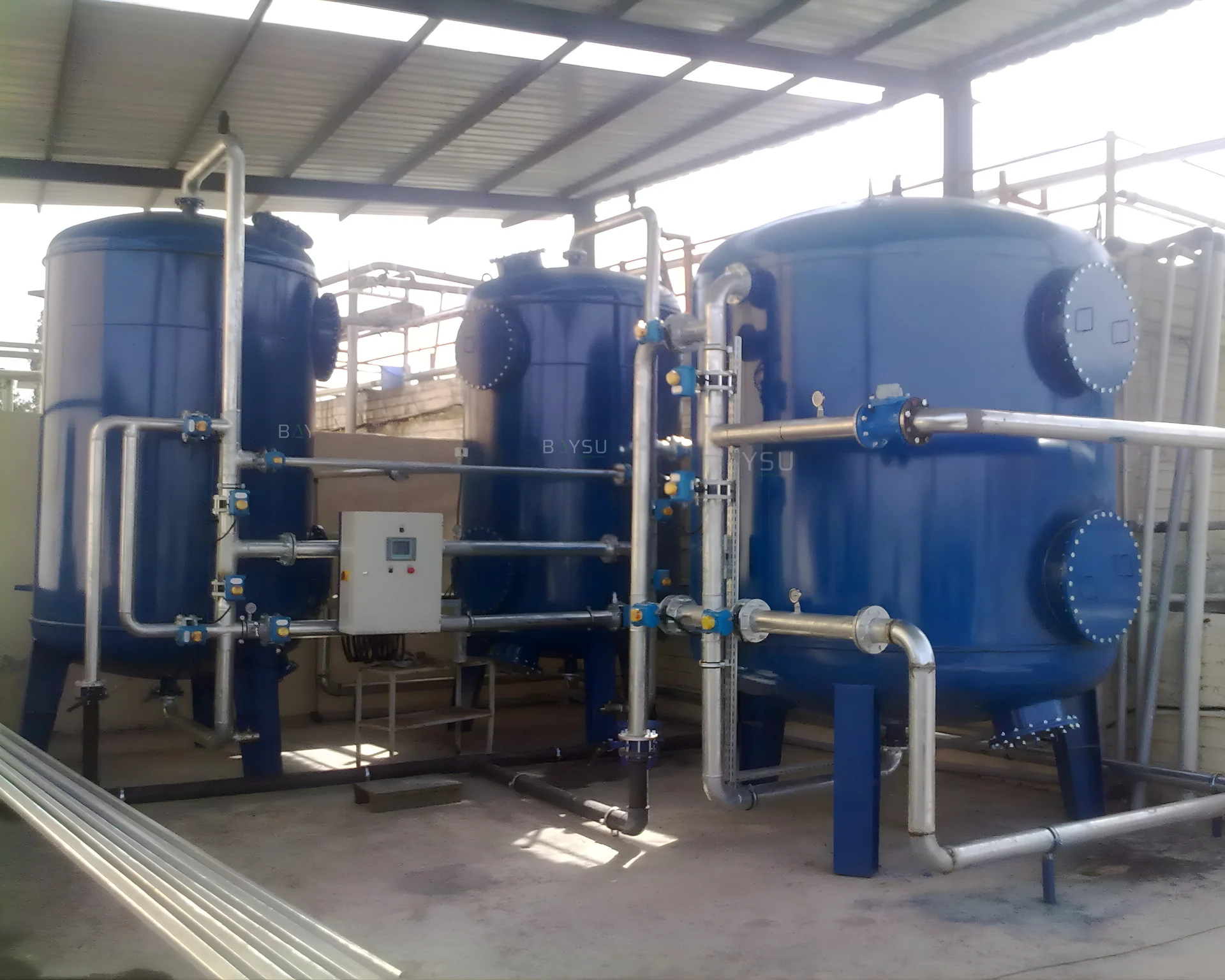
Sand and carbon filtration systems are effective water treatment solutions that remove sediment, suspended solids, chlorine, bad odors, and organic compounds through physical and chemical adsorption. They are also indispensable in the pretreatment of reverse osmosis and membrane systems. They offer a 99% particle removal performance in industrial and domestic water treatment applications.
What is Sand and Carbon Filtration?
Sand and carbon filtration systems are the cornerstone of physical and chemical treatment technologies in water treatment processes. These systems remove undesirable elements from water using various filling materials such as quartz sand, anthracite, and activated carbon. Therefore, they are commonly preferred for pre-treatment before drinking water, process water, and reverse osmosis systems.
Sand filters operate on the principle of physical filtration. The layered quartz sand and anthracite within the bed mechanically retain sediments, suspended solids, sludge, and large particles present in the water. In addition, carbon filters operate on the principle of chemical adsorption and remove chlorine, organic compounds, and taste and odor-causing substances from water by capturing them on the porous surface of activated carbon.
As a result, sand and carbon filtration systems are ideal solutions for pre-treatment of well water, tap water, and seawater, as well as for protective treatment before MBR systems. Moreover, thanks to the automatic backwashing feature, they operate continuously for long periods with minimal intervention. Custom designs can be made for both industrial and domestic applications of any scale.
Filtration systems provide high efficiency with a working pressure between 4-10 bar. Carbon steel (epoxy coated) or FRP composite is preferred as tank material. The layered structure of the filter bed and the correct selection of filling materials directly affect performance. Additionally, with PLC-based automation, backwashing, rinsing, and service cycles occur fully automatically.

Filter Types
- Sand Filter: Mechanical particle retention with layered quartz sand and anthracite
- Activated Carbon Filter: Adsorption of chlorine, odor, and organic matter with granular activated carbon
- Multimedia Filter: Combination of anthracite, garnet, and silex
- Iron-Manganese Filter: Metal removal with Birm or MTM
- Softening System: Hardness removal with resin ion exchange
- Cartridge Filter: Polypropylene 5-50 micron precision filtration
- Bag Filter: For flows with high solid content
- Disc Filter: Compact structure with an automatic cleaning system
Application Areas
- Drinking Water Preparation: City network, well water before final consumption
- RO Pre-Treatment: Reverse osmosis system membrane protection
- Industrial Process Water: Textile, food, chemical production
- Pool and SPA: Swimming pool water filtration
- Irrigation Systems: Before drip irrigation lines
- Hotels and Resorts: Network quality improvement
- Greenhouse and Agriculture: Water treatment for production facilities
- Wastewater Recovery: Advanced filtration after MBR
How Do Filtration Systems Work?
Sand filters operate on the principle of flow from top to bottom. Water enters the bed through the distribution head at the top of the tank. Therefore, it first passes through a fine anthracite layer, then through a medium-sized quartz sand layer, and finally through a coarse gravel layer at the bottom. This layered structure effectively retains particles of different sizes.
Carbon filters, on the other hand, use activated carbon filling in a similar flow geometry. Additionally, due to the high surface area of activated carbon (1 gram of carbon = 1000 m² surface), chlorine, organic molecules, and odor-causing compounds in the water are adsorbed into the pores. In our modern systems, NSF-approved quality activated carbon is used.
As a result, both types of filters require periodic backwashing. When the filter becomes clogged, the pressure drop increases, and the PLC automatically initiates the backwashing cycle. This cycle lasts for 10-15 minutes. During backwashing, the particles retained by the reverse flow are expelled from the filter bed and sent to the drain. Moreover, when combined with UV disinfection, microbiologically safe water is obtained.

Advantages of Filtration
Project Gallery
4 fotoğraf

Other Services
Package Treatment Plant — Wastewater Treatment Systems
Package treatment facility is a compact-sized and modularly designed wastewater treatment system. Our package treatment ...
Detailed InformationMBR Wastewater Treatment - Membrane Bioreactor Systems
MBR Wastewater Treatment (Membrane Bioreactor) systems combine biological treatment with membrane filtration in a single...
Detailed InformationMBBR Wastewater Treatment - Moving Bed Biofilm Systems
MBBR wastewater treatment systems are a modern technology that provides high treatment efficiency thanks to the biofilm ...
Detailed InformationBiological Wastewater Treatment - Activated Sludge Systems
Biological wastewater treatment is a natural and efficient method of wastewater treatment that utilizes microorganisms. ...
Detailed InformationIndustrial Wastewater Treatment - Solutions for Industrial Facilities
Industrial wastewater treatment plants are advanced technology systems designed for the treatment of factory and industr...
Detailed InformationLamella Settling and Sedimentation Systems
Lamella sedimentation systems are a high-efficiency solid-liquid separation technology implemented on inclined plates. T...
Detailed InformationTreatment Plant Operation Services
Wastewater treatment plant operation service ensures the professional management of your existing facility with our expe...
Detailed InformationUV Disinfection Systems
UV disinfection systems are environmentally friendly solutions that disinfect water using ultraviolet rays without the u...
Detailed InformationReverse Osmosis Systems
Reverse osmosis (RO) systems are advanced treatment technologies that purify water at high pressure using semi-permeable...
Detailed InformationMobile RO Water Treatment Systems
Mobile RO water treatment systems are portable solutions that integrate reverse osmosis technology on a container or tra...
Detailed InformationUltrafiltration UF Systems
Ultrafiltration UF systems are advanced treatment technologies that remove microorganisms, suspended solids, and high mo...
Detailed InformationTrailer Water Treatment Systems
Trailer water treatment systems are mobile solutions that are integrated onto a trailer and can be transported to the de...
Detailed InformationFrequently Asked Questions
Both are complementary systems that remove different pollutants. Generally, a sand filter (sediment/AKM removal) is used first, followed by a carbon filter (chlorine/odor/organic). This sequence provides optimal efficiency. If there are high particles in the water, the sand filter is prioritized; if there is a chlorine problem, the carbon filter is prioritized.
Quartz sand bed operates with performance for 3-5 years, after which replacement is recommended. Activated carbon should be replaced within 1-2 years. Additionally, the durations may vary depending on the water quality and filtration load. Regular analysis optimizes the timing of replacement.
Yes, sand and carbon filtration is the standard pre-treatment for reverse osmosis systems. The sand filter retains particles that will clog the membrane, while the carbon filter holds back chlorine and oxidizing substances that could damage the membrane. Complete protection is provided with a 5-micron cartridge filter.
The backwash cycle requires approximately 5-10 times the volume of the filter tank in water. For example, 5-10 m³ of backwash water is needed for 1 m³ of filter media. This water can be unfiltered raw water. Backwashing lasts for 10-15 minutes and is triggered 1-2 times a day.
FRP (fiberglass) tanks are preferred at low to medium pressures (4-7 bar). They are corrosion-resistant, lightweight, and economical. Steel tanks (epoxy-coated) are used at high pressures (7-10 bar) and in large capacities. In terms of temperature resistance and mechanical durability, steel is superior.
The cost of the filtration system is calculated on a project-specific basis according to capacity, the characteristics of the water source, and the selected filter type. In addition, the tank material (FRP or steel), level of automation, and the cost of filling materials also affect the cost. For a detailed quotation, you can contact our expert team. The operating cost is very low, with the main expense being periodic filling renewal.