

























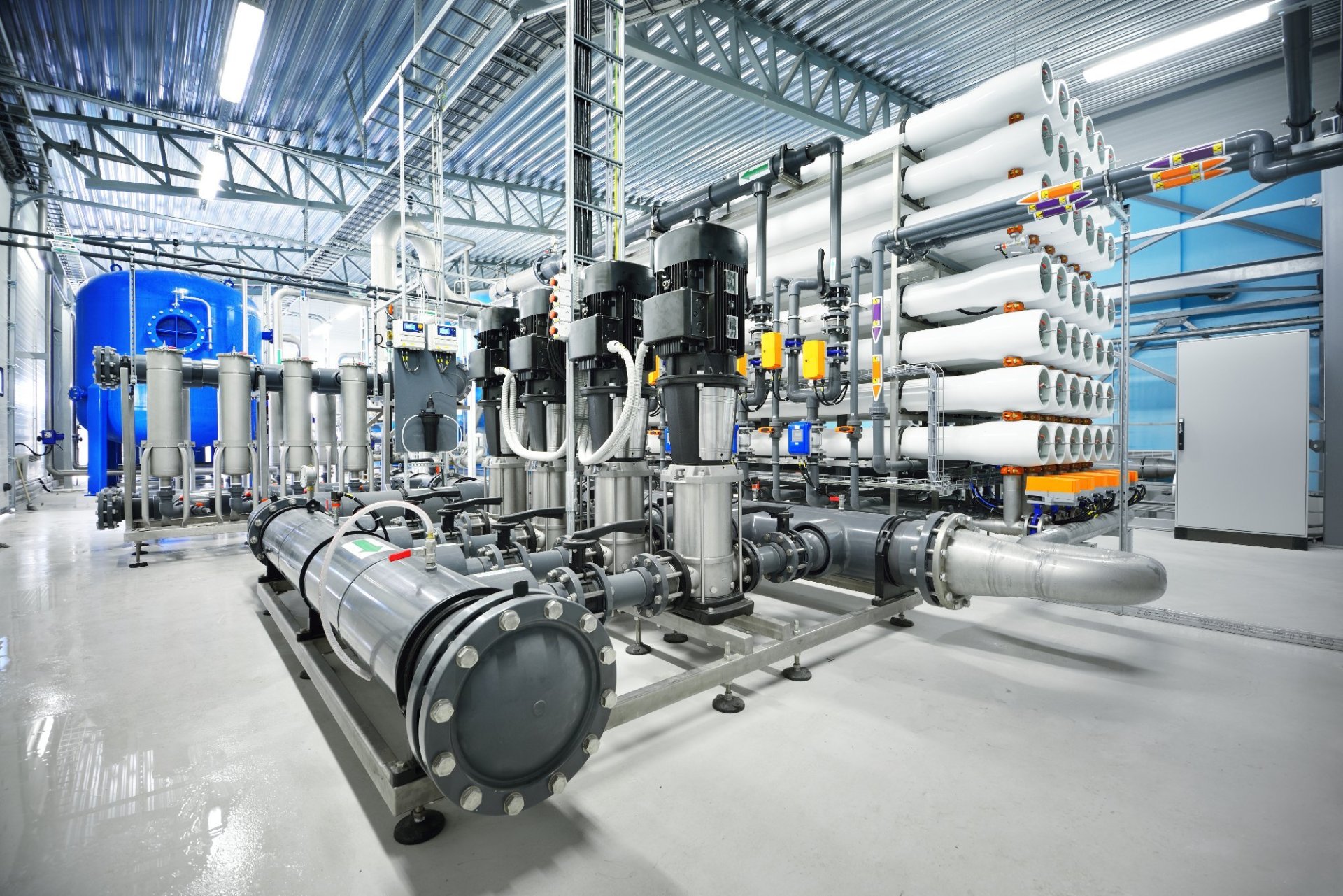
Reverse osmosis (RO) systems are advanced treatment technologies that purify water at high pressure using semi-permeable membranes to remove salts, minerals, and dissolved substances. They are also used in drinking water, industrial process water, and seawater treatment with a salt removal rate of 99.7%. It is the most effective solution for well water, municipal water, and wastewater recovery.
What is a Reverse Osmosis System?
Reverse osmosis systems are advanced treatment technologies that eliminate salts, minerals, heavy metals, and dissolved substances by passing water through semi-permeable membranes under high pressure. This method operates on the principle of the reverse of the natural osmosis phenomenon. Therefore, the membrane allows only water molecules to pass while retaining contaminants.
Reverse osmosis systems provide a salt removal rate between 95% and 99.7%. In addition, they effectively remove arsenic, fluoride, nitrate, and heavy metals. It is an indispensable technology, especially for the treatment of groundwater with high mineral content, hard tap water, and seawater.
As a result, reverse osmosis systems are commonly used in drinking water, industrial process water, boiler feed water, and in the recovery of water after MBR systems. Furthermore, when combined with UV disinfection, safe water is obtained from a microbiological perspective as well.

Technical Specifications
- Membrane Type: Polyamide (TFC) spiral wound membrane
- Salt Removal Rate: 95% - 99.7% high selective performance
- Capacity Range: 1 - 1000 m³/hour custom design
- Recovery Rate: 50% - 80% (depending on water source)
- Operating Pressure: 8 - 70 bar (depending on application)
- Body Material: Stainless steel or FRP composite
- Energy Consumption: 1 - 3 kWh/m³ efficient operation
- Automation: PLC + SCADA + remote monitoring
Application Areas
- Drinking Water Facilities: City and municipal water treatment
- Industrial Process Water: Textile, food, pharmaceutical, chemical
- Boiler Feed Water: Power plants, steam boilers
- Seawater Treatment: Coastal facilities, ships, hotels
- Well Water Treatment: Hardness, iron, manganese removal
- Wastewater Reclamation: Advanced treatment after MBR
- Hotels and Resorts: Supply of drinking and pool water
- Hospitals and Laboratories: Purified water needs
How Does Reverse Osmosis Work?
In the reverse osmosis system, water first goes through the pre-treatment stage. In this stage, coagulation, sand filtration, and cartridge filters are used to remove large particles and suspended solids. Additionally, anti-scalant and chlorine removal chemicals are dosed to protect the membrane.
After pre-treatment, the water is compressed by a high-pressure pump and directed to the membrane modules. Under high pressure, only pure water molecules pass through the membrane. Therefore, salts, minerals, and organic pollutants are collected in the concentrate flow. This side stream is referred to as "concentrate" or "brine".
As a result, the pure water (permeate) that passes through the membrane can be used directly or subjected to final treatment with UV disinfection. In modern systems, energy recovery units can reduce electricity consumption by 30-40%.

Advantages of Reverse Osmosis
Project Gallery
4 fotoğraf

Other Services
Package Treatment Plant — Wastewater Treatment Systems
Package treatment facility is a compact-sized and modularly designed wastewater treatment system. Our package treatment ...
Detailed InformationMBR Wastewater Treatment - Membrane Bioreactor Systems
MBR Wastewater Treatment (Membrane Bioreactor) systems combine biological treatment with membrane filtration in a single...
Detailed InformationMBBR Wastewater Treatment - Moving Bed Biofilm Systems
MBBR wastewater treatment systems are a modern technology that provides high treatment efficiency thanks to the biofilm ...
Detailed InformationBiological Wastewater Treatment - Activated Sludge Systems
Biological wastewater treatment is a natural and efficient method of wastewater treatment that utilizes microorganisms. ...
Detailed InformationIndustrial Wastewater Treatment - Solutions for Industrial Facilities
Industrial wastewater treatment plants are advanced technology systems designed for the treatment of factory and industr...
Detailed InformationLamella Settling and Sedimentation Systems
Lamella sedimentation systems are a high-efficiency solid-liquid separation technology implemented on inclined plates. T...
Detailed InformationTreatment Plant Operation Services
Wastewater treatment plant operation service ensures the professional management of your existing facility with our expe...
Detailed InformationUV Disinfection Systems
UV disinfection systems are environmentally friendly solutions that disinfect water using ultraviolet rays without the u...
Detailed InformationMobile RO Water Treatment Systems
Mobile RO water treatment systems are portable solutions that integrate reverse osmosis technology on a container or tra...
Detailed InformationSand and Carbon Filtration Systems
Sand and carbon filtration systems are effective water treatment solutions that remove sediment, suspended solids, chlor...
Detailed InformationUltrafiltration UF Systems
Ultrafiltration UF systems are advanced treatment technologies that remove microorganisms, suspended solids, and high mo...
Detailed InformationTrailer Water Treatment Systems
Trailer water treatment systems are mobile solutions that are integrated onto a trailer and can be transported to the de...
Detailed InformationFrequently Asked Questions
Modern reverse osmosis systems provide a salt removal rate between 95-99.7%. The recovery rate varies depending on the water source: a yield of 70-80% is obtained for well water, and 30-50% for seawater. When the system is designed correctly, it operates with high performance for many years.
The average lifespan of RO membranes is 3-5 years. With proper pretreatment, periodic chemical cleaning (CIP), and suitable operating conditions, this period can extend up to 7 years. Regular maintenance maximizes membrane lifespan.
Pre-treatment is critical for extending the lifespan of membranes and increasing efficiency. It generally includes stages such as sedimentation, sand filtration, activated carbon filtration, and anti-scalant dosing. Pre-treatment is simpler in the RO application following MBR systems.
Seawater RO systems (SWRO) operate at high pressure (55-70 bar) and with special seawater membranes. The recovery rate is around 40-50%. In modern systems, energy recovery units have reduced electricity consumption to levels of 2.5-3.5 kWh/m³.
Yes, RO is widely used in drinking water production worldwide. However, since it removes all minerals, it is recommended to perform mineral balancing (remineralization) on the output water. This way, the drinking water becomes both safe and nutritious.
The cost of the RO system is calculated specifically for the project based on capacity, the characteristics of the water source (well, network, seawater), and the desired quality. In addition, the need for pre-treatment, membrane type, and level of automation affect the cost. For detailed design, contact our expert engineering team.