

























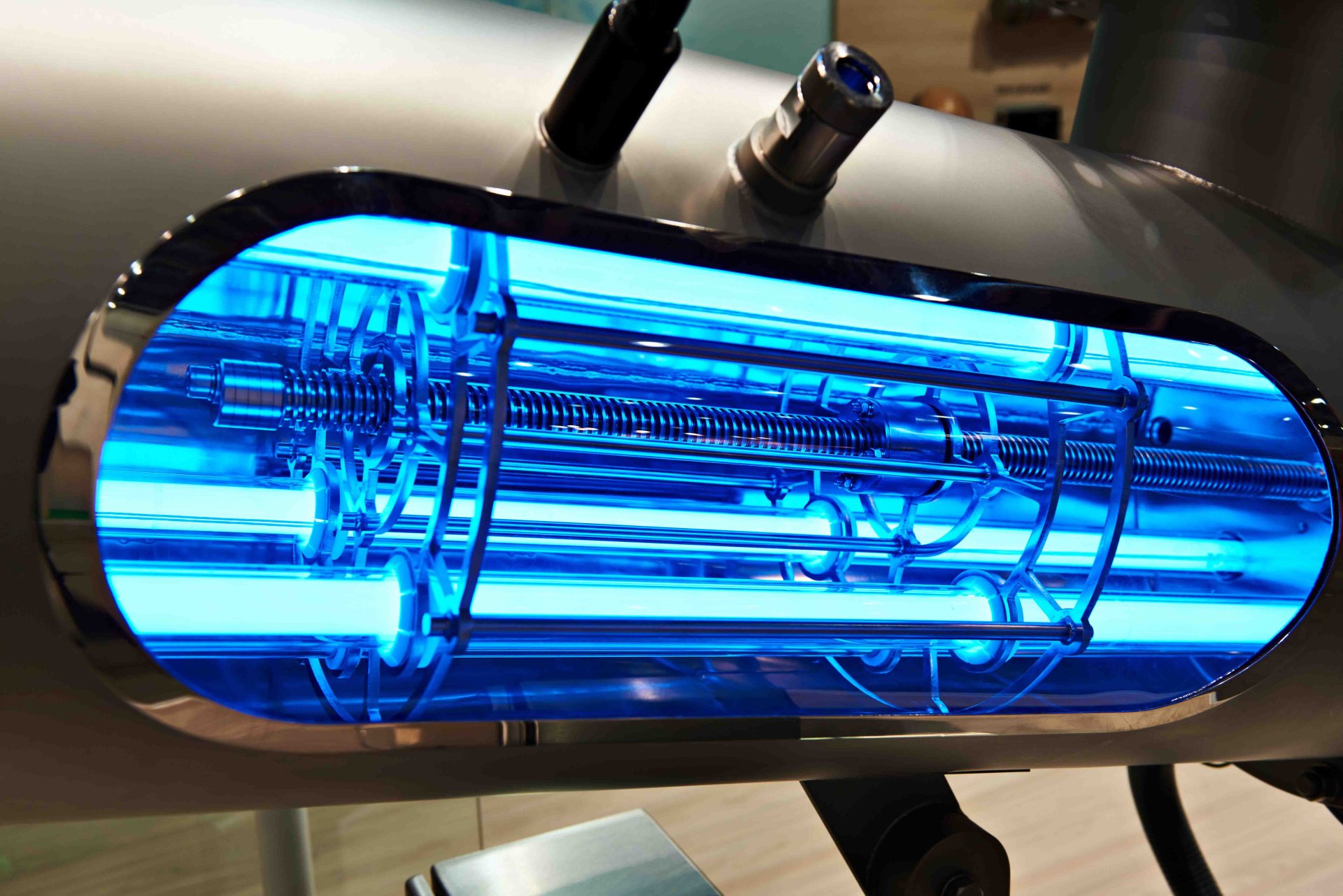
UV disinfection systems are environmentally friendly solutions that disinfect water using ultraviolet rays without the use of chemicals. They also provide 99.9% microorganism removal with 254 nm UV-C radiation. Bacteria, viruses, and fungal spores are rendered ineffective within seconds. They are suitable for drinking water, wastewater discharge, and process water applications.
What is a UV Disinfection System?
UV disinfection systems are modern and environmentally friendly disinfection technologies that eliminate microorganisms in water using ultraviolet rays. Additionally, since no chemical substances are used, it leaves no taste, odor, or residue in the water.
The principle of UV disinfection is based on UV-C rays with a wavelength of 254 nm. This light disrupts the DNA structure of bacteria, viruses, and fungal spores, preventing their reproduction and survival. Therefore, a minimum UV dose of 30,000 mW·s/cm² ensures 99.9% microorganism removal.
As a result, UV disinfection systems are widely used in drinking water, municipal tap water, pool water, and wastewater discharges. They are particularly preferred in the final disinfection stage after MBR systems and biological treatment facilities.

Technical Specifications
- UV Wavelength: 254 nm UV-C radiation (destroys microbial DNA)
- Lamp Type: Low pressure mercury vapor UV lamp
- UV Dose: Minimum 30,000 mW·s/cm² effective dose
- Lamp Life: 9,000 - 13,000 hours of continuous use
- Reactor Material: AISI 304/316 stainless steel or PVC
- Flow Capacity: Custom design in the range of 0.5 - 500 m³/hour
- Control System: PLC-based automatic monitoring and alarm
- Sensor: Continuous measurement with UV intensity sensor
Application Areas
- Drinking Water Facilities: Final disinfection of municipal tap water
- Wastewater Treatment Outlet: Final disinfection before discharge
- Pool and SPA: Swimming pool water disinfection
- Industrial Process Water: Microbiological quality control
- Food Industry: Production line water disinfection
- Aquarium and Fish Farm: Water sterilization
- Hospital and Laboratory: Sterile water production
- Beverage Factories: Production water disinfection
How Does UV Disinfection Work?
The UV disinfection system operates with UV-C lamps placed inside a stainless steel reactor. As water flows around the lamps, it is exposed to high-intensity ultraviolet rays. In addition, the reactor design ensures that every point of the water is exposed to adequate UV dosage.
The DNA and RNA structures of bacteria, viruses, and protozoa in the water absorb UV-C radiation. Therefore, microorganisms cannot reproduce and die rapidly. This process occurs within seconds.
As a result, UV disinfection is a much safer, faster, and environmentally friendly alternative compared to chlorinated disinfection. Moreover, it does not add taste or odor to the water and does not produce disinfection by-products (such as THM). Contact us for more information.

Advantages of UV Disinfection
Project Gallery
4 fotoğraf


Other Services
Package Treatment Plant — Wastewater Treatment Systems
Package treatment facility is a compact-sized and modularly designed wastewater treatment system. Our package treatment ...
Detailed InformationMBR Wastewater Treatment - Membrane Bioreactor Systems
MBR Wastewater Treatment (Membrane Bioreactor) systems combine biological treatment with membrane filtration in a single...
Detailed InformationMBBR Wastewater Treatment - Moving Bed Biofilm Systems
MBBR wastewater treatment systems are a modern technology that provides high treatment efficiency thanks to the biofilm ...
Detailed InformationBiological Wastewater Treatment - Activated Sludge Systems
Biological wastewater treatment is a natural and efficient method of wastewater treatment that utilizes microorganisms. ...
Detailed InformationIndustrial Wastewater Treatment - Solutions for Industrial Facilities
Industrial wastewater treatment plants are advanced technology systems designed for the treatment of factory and industr...
Detailed InformationLamella Settling and Sedimentation Systems
Lamella sedimentation systems are a high-efficiency solid-liquid separation technology implemented on inclined plates. T...
Detailed InformationTreatment Plant Operation Services
Wastewater treatment plant operation service ensures the professional management of your existing facility with our expe...
Detailed InformationReverse Osmosis Systems
Reverse osmosis (RO) systems are advanced treatment technologies that purify water at high pressure using semi-permeable...
Detailed InformationMobile RO Water Treatment Systems
Mobile RO water treatment systems are portable solutions that integrate reverse osmosis technology on a container or tra...
Detailed InformationSand and Carbon Filtration Systems
Sand and carbon filtration systems are effective water treatment solutions that remove sediment, suspended solids, chlor...
Detailed InformationUltrafiltration UF Systems
Ultrafiltration UF systems are advanced treatment technologies that remove microorganisms, suspended solids, and high mo...
Detailed InformationTrailer Water Treatment Systems
Trailer water treatment systems are mobile solutions that are integrated onto a trailer and can be transported to the de...
Detailed InformationFrequently Asked Questions
UV-C radiation is effective against a wide range of microorganisms, including E. coli, Salmonella, Legionella, Cryptosporidium, Giardia, viruses, and fungal spores. By applying a sufficient dose of 254 nm UV-C light, a microorganism removal rate of 99.9% is achieved.
UV disinfection is superior to chlorine disinfection in many ways: there is no chemical usage, disinfection by-products (THM, HAA) are not formed, it does not add taste and odor to the water, and it is faster. However, because it does not provide a residual effect, it is sometimes used in combination with chlorine in certain applications.
The average lifespan of low-pressure mercury vapor UV lamps is between 9,000 - 13,000 hours. This translates to approximately 12-18 months of continuous use. Lamp replacement is easy and can be performed while the system continues to operate.
UV disinfection is typically used in the final stage of wastewater treatment plants, prior to discharge. It is an ideal solution for the disinfection of effluent water after biological treatment, MBR systems, or MBBR technology.
No, the maintenance of the UV system is quite simple. Periodic cleaning of the quartz sleeves (every 6 months) and replacement of the UV lamp (1-2 times a year) is sufficient. In models with an automatic cleaning system, this process is also done automatically.
The cost of the UV disinfection system is calculated on a project-specific basis according to capacity, application type, and the selected lamp technology. Water flow rate, organic matter content, and the desired UV dose are the main parameters affecting the price. You can benefit from our free technical proposal and system sizing service for municipal, industrial, and drinking water applications.