












What is an Ultrafiltration UF System?
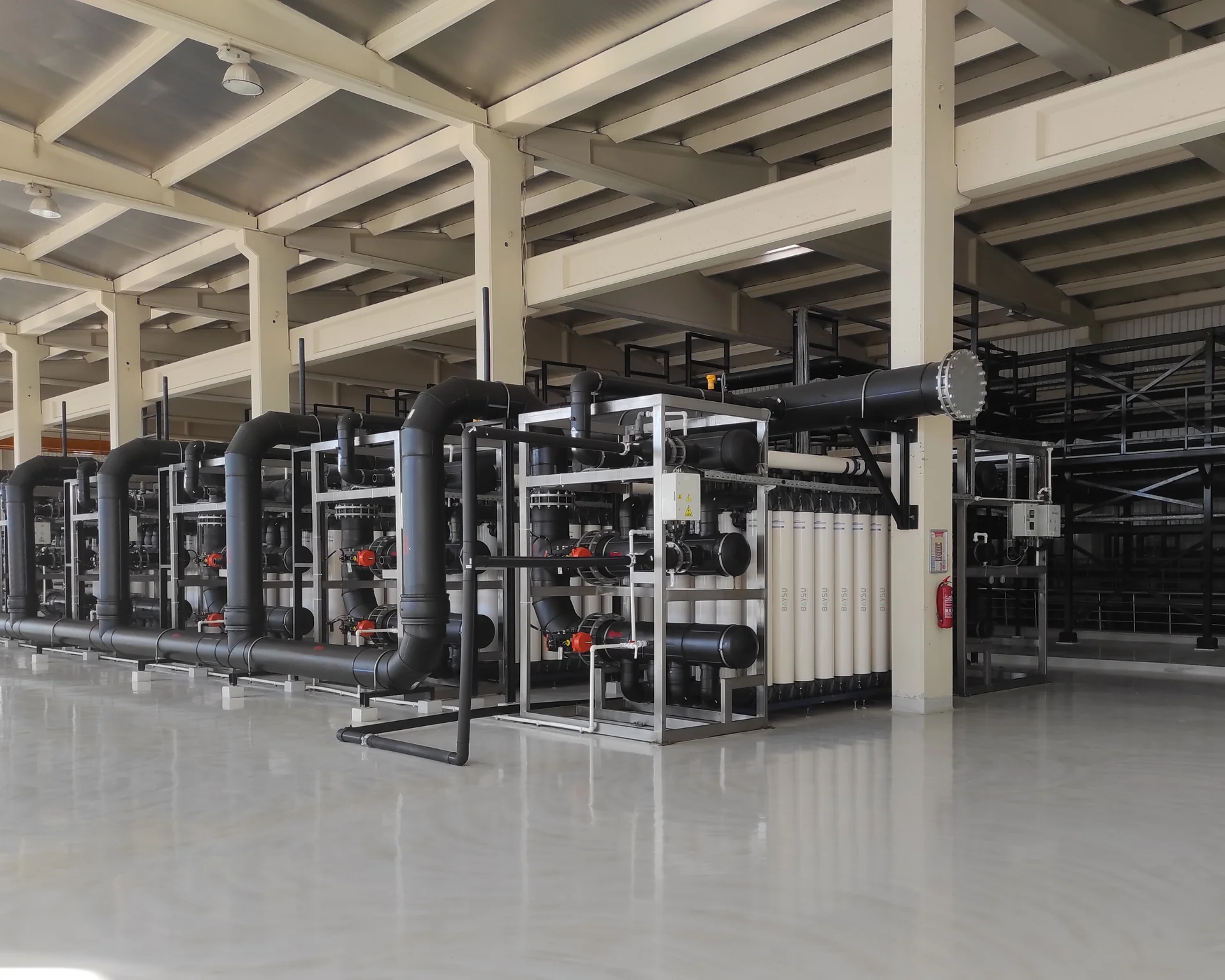
Ultrafiltration UF systems are advanced filtration technologies that purify water by passing it through semi-permeable membranes with pore sizes of 0.01-0.1 microns. Ultrafiltration systems, especially with hollow fiber structures made of PVDF and PES membranes, offer a high surface area. Therefore, they remove bacteria, viruses, parasites, suspended solids, and high molecular weight organic compounds with an efficiency of 99%.
UF systems operate on the principle of pressure difference. Water passes through the membrane pores only under low pressure of 1-5 bar. In addition, the water that passes is pure and microbiologically safe, while the retained particles are removed from the system through backwash. Moreover, energy consumption is minimized due to the low pressure.
As a result, ultrafiltration technology is widely preferred for pre-treatment before drinking water, process water, food and beverage production, and reverse osmosis systems. Furthermore, MBR bioreactor plants are actually a combination of biological treatment and UF technology. UF systems are environmentally friendly and provide a sustainable solution as they do not use chemicals.
Ultrafiltration systems are applied across a wide range from small plants to large industrial applications with their compact and modular design. Special projects are designed within the capacity range of 5-200 m³/hour. Thanks to PLC and SCADA automation, they operate fully automatically, with periodic backwashing and chemical cleaning (CIP) triggered automatically. The membrane lifespan is 5-7 years, providing low operating costs.

Technical Specifications
- Pore Size: 0.01 - 0.1 micron precision membrane filtration
- Membrane Material: PVDF, PES or polypropylene hollow fiber
- Operating Pressure: 1 - 5 bar low pressure operation
- Flux: 30 - 100 L/m²·hour membrane efficiency
- Removal Efficiency: Over 99% particle and microorganism
- Flow Capacity: Custom design in the range of 5 - 200 m³/hour
- Backwash: Automatic periodic cleaning
- CIP Cleaning: Chemical on-site cleaning system
Application Areas
- Drinking Water Preparation: Municipal and private drinking water facilities
- RO Pre-Treatment: Reverse osmosis membrane protection before treatment
- Food and Beverage: Milk, fruit juice, beverage production
- Industrial Process: Textile, paper, chemical, pharmaceutical
- Wastewater Recovery: Advanced filtration after tertiary treatment
- Swimming Pool: Water purification and disinfection
- Hospital and Laboratory: Preparation of sterile water
- Mining and Oil: Process water treatment
How Does Ultrafiltration Work?
Ultrafiltration UF systems operate with hollow fiber membrane modules. Each module consists of thousands of fine fibers, and each fiber acts like a mini filter. In addition, there are out-in or in-out flow configurations available.
Water is pumped onto the fiber surface under low pressure (1-5 bar). Therefore, only water molecules and dissolved minerals pass through the 0.01-0.1 micron pores. Bacteria, viruses, suspended solids, and high molecular weight organics are retained on the fiber surface. The resulting clean water is referred to as permeate.
As a result, the particles accumulated on the filter surface are removed at regular intervals through automatic backwashing. Moreover, membrane performance is maintained with chemical in-place cleaning (CIP) every 1-3 months. When combined with UV disinfection, absolute microbiological safety is ensured.
Advantages of Ultrafiltration
Project Gallery
4 fotoğraf

Other Services
Package Treatment Plant — Wastewater Treatment Systems
Package treatment facility is a compact-sized and modularly designed wastewater treatment system. Our package treatment ...
Detailed InformationMBR Wastewater Treatment - Membrane Bioreactor Systems
MBR Wastewater Treatment (Membrane Bioreactor) systems combine biological treatment with membrane filtration in a single...
Detailed InformationMBBR Wastewater Treatment - Moving Bed Biofilm Systems
MBBR wastewater treatment systems are a modern technology that provides high treatment efficiency thanks to the biofilm ...
Detailed InformationBiological Wastewater Treatment - Activated Sludge Systems
Biological wastewater treatment is a natural and efficient method of wastewater treatment that utilizes microorganisms. ...
Detailed InformationIndustrial Wastewater Treatment - Solutions for Industrial Facilities
Industrial wastewater treatment plants are advanced technology systems designed for the treatment of factory and industr...
Detailed InformationLamella Settling and Sedimentation Systems
Lamella sedimentation systems are a high-efficiency solid-liquid separation technology implemented on inclined plates. T...
Detailed InformationTreatment Plant Operation Services
Wastewater treatment plant operation service ensures the professional management of your existing facility with our expe...
Detailed InformationUV Disinfection Systems
UV disinfection systems are environmentally friendly solutions that disinfect water using ultraviolet rays without the u...
Detailed InformationReverse Osmosis Systems
Reverse osmosis (RO) systems are advanced treatment technologies that purify water at high pressure using semi-permeable...
Detailed InformationMobile RO Water Treatment Systems
Mobile RO water treatment systems are portable solutions that integrate reverse osmosis technology on a container or tra...
Detailed InformationSand and Carbon Filtration Systems
Sand and carbon filtration systems are effective water treatment solutions that remove sediment, suspended solids, chlor...
Detailed InformationTrailer Water Treatment Systems
Trailer water treatment systems are mobile solutions that are integrated onto a trailer and can be transported to the de...
Detailed InformationFrequently Asked Questions
Microfiltration (MF) retains only suspended solids with a pore size of 0.1-1 micron. Ultrafiltration (UF), on the other hand, performs more precise filtration with a pore size of 0.01-0.1 micron and also removes viruses, bacteria, and high molecular weight organics. UF provides treatment at a disinfection level.
It depends on your selection needs. UF (0.01-0.1 micron) does not remove dissolved salts and minerals; it only eliminates microorganisms and particles. Reverse osmosis (0.0001 micron), on the other hand, removes everything, including salts. If salt removal is not required, UF is a more economical and energy-efficient choice. If salt removal is necessary, pre-treatment with UF before RO is the ideal combination.
The most common structure of hollow fiber UF membranes is that each fiber is in the shape of a hollow tube with a diameter of less than one millimeter, and thousands of them are gathered in a module. This allows for 50-100 m² of filtration surface to fit into an area of 1 m². PVDF and PES are common materials.
UF membranes are cleaned at two levels. Backwashing is performed automatically every 15-60 minutes and lasts for 1-3 minutes. Chemical In-Place cleaning (CIP) is applied every 1-3 months and dissolves organic/inorganic contaminants. Regular cleaning extends the membrane lifespan to 5-7 years.
UF systems have a wide range of applications, including drinking water preparation, MBR systems, food and beverage (milk, fruit juice), textiles, pharmaceuticals, hospitals, swimming pools, wastewater recovery, and pre-treatment for RO. It has become a standard component of modern treatment plants.
The cost of the UF system is calculated specifically for the project based on capacity, membrane type, and application. The quality of the water source, the level of automation, and the cost of the cabin/tank materials are the main parameters that affect the cost. You can contact us for a detailed quote.