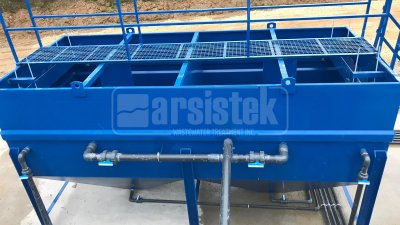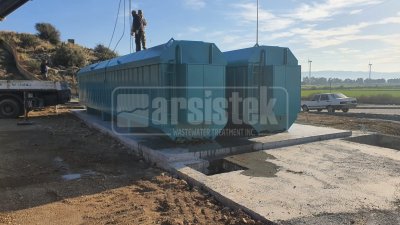






















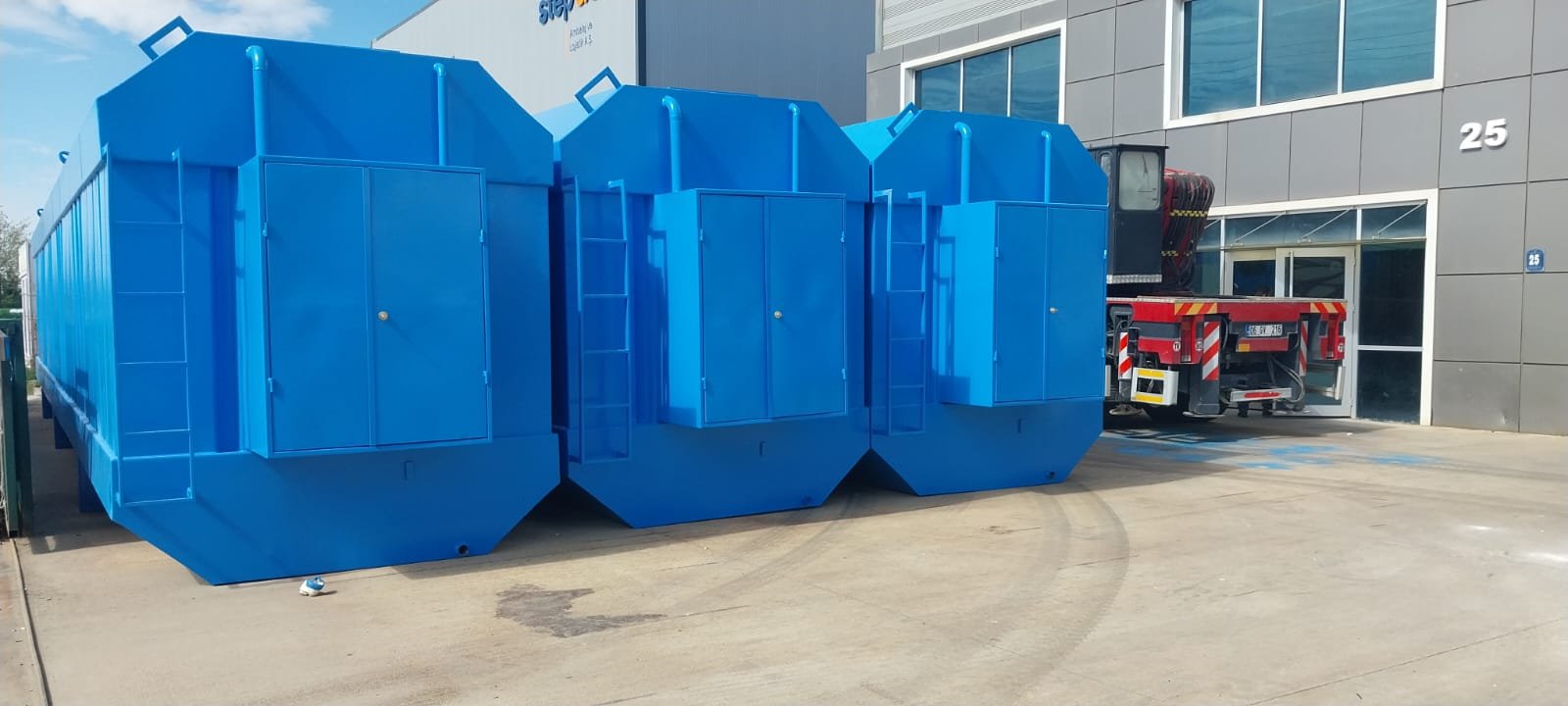
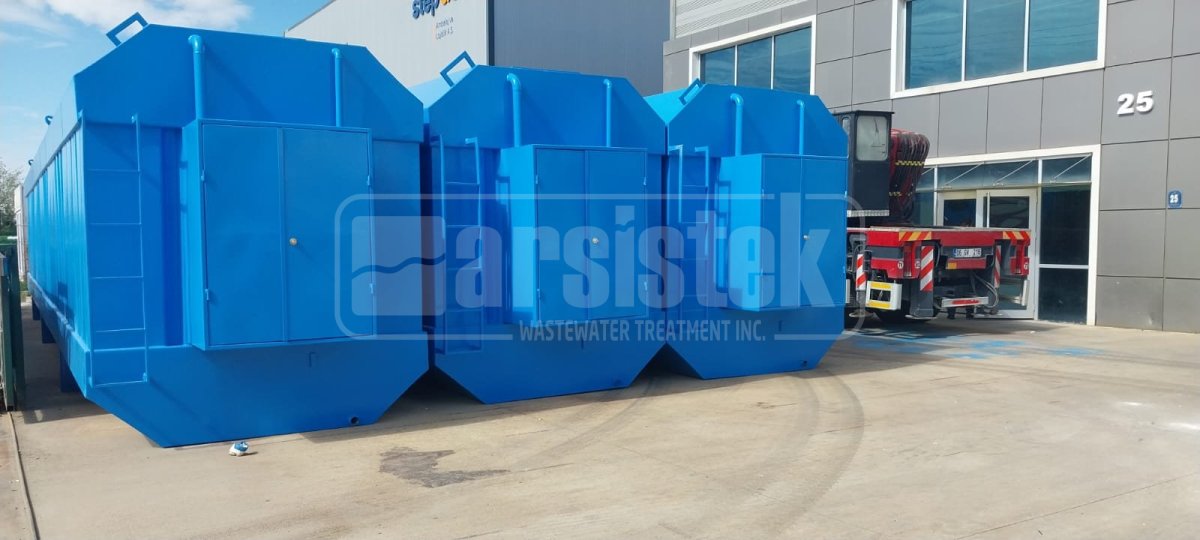
Short answer: A package treatment system is a prefabricated facility that combines all process equipment of a wastewater treatment plant (screening, balancing, biological reactor, sedimentation or membrane, disinfection, automation) in compact steel or concrete modules manufactured in a factory environment. It is transported to the site and commissioned within 1-4 weeks. It is used in all applications with a flow rate of 2-2,000 m3/day, such as hotels, factories, single-member OSB factories, construction sites, and small municipalities.
What is package treatment? Definition of Package Treatment
Package treatment (English: package treatment plant, prefabricated wastewater treatment) refers to the compact version of traditional wastewater treatment processes produced in a factory environment as an alternative to full-scale concrete construction facilities. This approach:
- Eliminates long construction periods on site
- Offers standard quality and performance guarantees
- Provides quick commissioning
- Allows for modular expansion
Package systems take advantage of mass production through factory assembly — instead of hours of work on site, work equivalent to a year is completed in days in a controlled factory environment.
Difference from Classic Facilities
| Feature | Package System | Classic Concrete Construction |
|---|---|---|
| Production location | Factory (controlled) | Site (varies) |
| Installation time | 1-4 weeks | 6-18 months |
| Standard quality | High (factory QC) | Dependent on site conditions |
| Space requirement | Very low (30-50% less) | Standard |
| Portability | Yes (container unit) | No (fixed) |
| Expandability | Modular (add in parallel) | Difficult (reconstruction) |
| Optimal capacity | 2-2,000 m3/day | 500+ m3/day |
| Lifespan | 15-25 years (steel) | 30-50 years (concrete) |
| Investment (relative) | Low-medium | Medium-high |
| Operation | Automatic (single operator) | Standard (shift-based) |
6 Key Advantages of Package Treatment
- Fast installation: 1-4 weeks instead of 6-18 months. A critical advantage in urgent needs.
- Standard quality guarantee: With factory-controlled production, every facility has the same performance.
- Compact area: 30-50% less land compared to concrete facilities. Critical in urban, OSB inner plots.
- Portability: Those in container unit form can be moved to another site in the future — ideal for temporary construction sites, seasonal facilities.
- Modular expansion: When capacity needs to be increased, parallel units are added without taking the existing facility offline.
- Automation ready: SCADA + PLC + sensors are pre-integrated, making commissioning easy.
Components of Package Treatment
A package treatment system consists of a varying number of compact modules depending on capacity. Typical components include:
1. Mechanical Pre-Treatment Module
- Coarse screen (5-20 mm) — for large particles
- Fine screen (1-3 mm) — for small solids
- Sand trap — to protect the pump
- Oil separator (if necessary)
2. Balancing Tank
It smooths out fluctuations in flow and composition. Provides ideal conditions for biological processes with automatic pH adjustment (NaOH/H2SO4 dosing). HRT 6-24 hours.
3. Biological Reactor (Heart of the Facility)
Varies according to the selected process type in the package system:
- Activated sludge: Aeration tank
- MBBR: Plastic carrier reactor
- MBR: Submerged UF/MF membrane reactor
- SBR: Periodic batch reactor in a single tank
4. Solid-Liquid Separation Module
- Lamella separator (compact sedimentation)
- Or submerged UF membrane (in MBR)
- Or SBR sedimentation phase (internal)
5. Disinfection Unit
- UV lamp — standard in modern package systems
- Chlorination dosing — classic method
- Ozone generator — for premium applications
6. Sludge Management Module
- Sludge thickening tank
- Polymer dosing system
- Some packages include mini decanter or screw press
7. Auxiliary Equipment
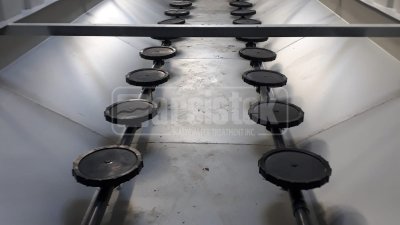
- Blowers (air blowers) — for aerobic bacteria O2
- Fine bubble diffusers
- Pumps (transfer, dosing, sludge)
- Dosing systems (NaOH, FeCl3, polymer, etc.)
- PLC + SCADA automation
- Sensors (DO, pH, level, temperature)
- Control panel + electrical distribution
Types of Package Treatment
| Type | Description | Typical Use |
|---|---|---|
| Classic activated sludge package | Traditional process, economical | Small municipality, rural site |
| SBR package | Periodic batch, modular | Hotel, small factory, OSB unit |
| MBBR package | Shock load resistant, retrofit | Seasonal fluctuation (hotel/tourism) |
| MBR package | Highest effluent quality, water recovery | Sensitive receiving environment, high quality |
| Container MBR | Facility inside a 20-40 ft container | Construction site, ship, temporary site |
| Underground package | Buried underground | Aesthetic critical (villa, hotel garden) |
| Steel tank package | Modular steel body | Quick installation (15-25 years lifespan) |
| Mini concrete package | Ready-made concrete module | Permanent facilities (30+ years lifespan) |
In Which Sectors is Package Treatment Used?
- Tourism: Hotel, motel, holiday village, camping, restaurant
- Residential: Site, apartment complex, housing, villa
- Industry: Small-medium factory, single-member OSB, mobile production
- Municipality: Village, town, small locality (50-2,000 m3/day)
- Transportation: Highway rest area, airport satellite, station
- Education: School, university campus, dormitory
- Health: Small clinic, dispensary, health center
- Temporary facilities: Construction camp, military base, event area
- Maritime: Ship, offshore platform, marina
- Agricultural: Farm, greenhouse complex, food processing
What Type of Wastewater Does Package Treatment Treat?
| Wastewater Type | Suitability | Note |
|---|---|---|
| Domestic wastewater | Ideal | Designed for standard packages |
| Hotel/restaurant (grey + black water) | Ideal | Oil separator + package biological |
| Food factory (dairy, beverage) | Suitable | Industrial MBR package + DAF |
| Slaughterhouse | Suitable | DAF + UASB + MBR package |
| Hospital | Suitable (special) | MBR + ozone/GAC package |
| Textile/dyehouse | Partial | Only some lines, additional treatment required for color |
| Heavy industrial (chemical/metal) | Limited | Multi-barrier additional treatment required |
| Rainwater | Not suitable | Different system (rainwater harvesting) |
Effluent Water Quality
The effluent water quality of package treatment varies by type and technology:
- Classic activated sludge package: KOİ < 100, BOİ < 25, AKM < 30 mg/L
- SBR package: KOİ 50-100, BOİ 15-30, AKM 20-40 mg/L
- MBBR package: KOİ 40-80, BOİ 10-20, AKM 15-30 mg/L
- MBR package: KOİ 15-30, BOİ < 5, AKM < 1, pathogen 5-6 log reduction
When the effluent water is subjected to UV disinfection, it meets the SKKY reuse Class A standard — safely used for landscape irrigation, cooling tower feed, toilet/cleaning.
Package Treatment vs Alternatives
vs Septic Tank
A septic tank only performs sedimentation; there is no biological treatment. Effluent water has KOİ 200-400 mg/L (limit exceedance). Regular vacuum pumping is required. It is being phased out under modern regulations. Package treatment is over 95% more efficient.
vs Municipal Sewer
If there is a municipal sewer connection, it is already the most economical solution. However: if there is no sewer (rural), if the sewer capacity is insufficient, or if it is required to meet OSB acceptance standards, the package system becomes mandatory.
vs Classic Concrete Facility
Detailed in the comparison table above. For capacities below 500 m3/day, packages are generally more economical, while for higher capacities, concrete facilities gain an advantage.
3 Frequently Confused Terms
- Package treatment ≠ Septic tank: A septic tank only sediments, there is no biological treatment. Package treatment provides a full-scale biological process + quality above effluent standards.
- Package treatment ≠ Tight pit: A tight pit is not treatment, it is storage. It is emptied with a vacuum tanker. Package treatment is continuous operation and actual treatment.
- Package treatment ≠ Mobile treatment: Mobile treatment is a temporary system built on a wheeled vehicle. Package treatment is fixed but prefabricated. Container package systems are an intersection of the two.
5 Advantages of Package Treatment Investment
- Fast payback: Compliance with regulations + prevention of penalties allows the investment to pay back quickly.
- Modular growth: As the company or facility grows, parallel units are added.
- Standard performance: With factory guarantees, every facility has the same quality.
- Quick commissioning: In urgent situations, the facility can be operational within 1-4 weeks.
- Water recovery potential: In MBR packages, effluent water can be reused directly.
Conclusion
Package treatment is the solution that brings together the speed + compactness + standard quality triangle of modern wastewater management. It offers 30-50% less space compared to classic concrete construction facilities, 5-10 times faster installation, and modular expansion advantages. It is an ideal option for all facilities with a flow rate of 2-2,000 m3/day, such as hotels, factories, OSBs, small municipalities, and construction sites. The correct type (MBR/MBBR/SBR/activated sludge) selection depends on wastewater characterization, discharge limits, and recovery goals.
Detailed guides: How Package Treatment Works?, Capacities and Sizing Guide, MBR vs MBBR, SBR vs MBR. You can request a free preliminary study from our Arsistek engineering team for the right package system selection for your facility.
Atıksu arıtma uzmanı, çevre mühendisi. Endüstriyel su arıtma projelerinde 20+ yıl saha deneyimi.