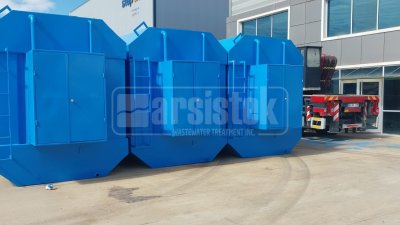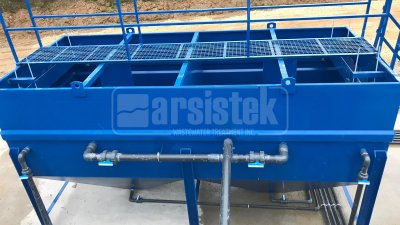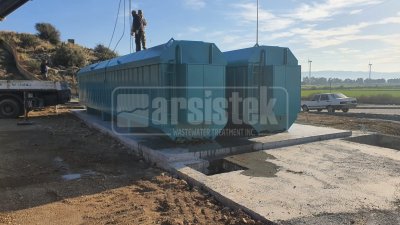























Short answer: The package treatment system treats wastewater in 5 stages: (1) Mechanical pre-treatment (screening, balancing), (2) Biological treatment (decomposition of organic matter by aerobic bacteria), (3) Settling or membrane separation, (4) Disinfection (UV or chlorine), (5) Effluent. All these stages are collected in factory-produced compact steel or concrete modules; transported to the site and commissioned within 1-4 weeks. Typical effluent quality: KOİ < 100, BOİ < 25, AKM < 30 mg/L (standard), < 1 mg/L AKM with MBR.
What is Package Treatment?
A package wastewater treatment plant is a version of traditional wastewater treatment processes (activated sludge, MBR, MBBR, SBR) that is manufactured in a factory and delivered to the site as a compact module. As the name suggests, the facility comes in a "package"; it does not require reinforced concrete pool construction or a project process lasting for years.
3 main advantages:
- Fast installation: Commissioned within 1-4 weeks (classic plants 6-18 months)
- Compact: Inside a container or steel tank — minimum space
- Portable: Ideal for temporary construction sites, seasonal tourist facilities
Which Facilities Are Suitable?
| Usage Location | Typical Flow Rate | Recommended Type |
|---|---|---|
| Villa / small site | 2-20 m3/day | Mini package (MBBR/activated sludge) |
| Hotel (50-200 rooms) | 15-150 m3/day | SBR or MBR package |
| Highway rest area | 10-50 m3/day | MBBR + lamella |
| Small factory | 20-200 m3/day | Industry-specific (MBR common) |
| Construction site / temporary camp | 5-100 m3/day | Container MBR |
| Village / small municipality | 50-500 m3/day | SBR or MBR |
| OSB single factory | 100-1,000 m3/day | Industrial MBR package |
| Ship / offshore platform | 5-50 m3/day | Marine MBR (certified) |
Package Treatment Working Stages
1. Mechanical Pre-Treatment
The first stop of wastewater — separation of coarse particles:
- Coarse screen: 10-20 mm spacing — retains fabric, plastic, wood particles
- Fine sieve (static or rotating drum): 1-3 mm — hair, fibers, small solids
- Sand trap (if necessary): Retains sand, gravel — protects the pump
- Grease separator (for kitchen wastewater): In hotel/restaurant facilities
2. Balancing (Grease and Flow)
The flow rate of wastewater fluctuates 3-10 times during the day — a balancing tank is used to provide a stable flow to the biological process. Typical HRT is 6-12 hours. At this stage:
- Pik flows are reduced → biological process does not receive shock
- pH is stabilized in the range of 6.5-8 (automatic dosing if necessary)
- Temperature is homogenized
- Composition is homogenized (CIP softens wash spikes)
3. Biological Treatment (The Heart of the Facility)
The most critical step of package treatment. Organic matter (BOİ/KOİ), nitrogen (NH4), and phosphorus (PO4) in wastewater are decomposed here by microorganisms. Three main methods are used in package systems:
a) Classic Activated Sludge
Aerobic bacteria consume organic matter in the aeration tank. Subsequently, biomass is separated as sludge in the final settling tank. Simple but requires more space.
b) MBBR (Moving Bed Biofilm Reactor)
Plastic carriers (K1, K3, K5 carrier) are added to the reactor; bacteria form biofilm on the carrier surface. High concentrated biomass → compact system. Very resistant to shock loads. Check our comparison of MBR and MBBR.
c) MBR (Membrane Bioreactor)
Activated sludge process + UF/MF membrane filtration. The membrane brings the AKM of the effluent close to zero, retaining 100% of bacteria and viruses. Effluent quality is top-notch. Water can be recovered.
d) SBR (Sequencing Batch Reactor)
Operates the activated sludge process in a single tank with a 5-stage periodic cycle (filling → reaction → settling → emptying → waiting). Automation is critical; common for small-medium package systems. Detailed comparison of SBR vs MBR.
4. Solid-Liquid Separation
After biological treatment, clean water and sludge are separated:
- Activated sludge/MBBR: Final settling tank or lamella separator
- MBR: Submerged UF/MF membrane (inside the tank)
- SBR: Separation is done inside the reactor during the settling phase
5. Disinfection
To kill remaining pathogens in the effluent:
- UV (ultraviolet) lamp: Standard in modern package systems, chemical-free
- Chlorine dosing (NaOCl): Classic method, cheap but leaves residue
- Ozone: Very high efficiency, premium applications
MBR effluent already has a 5-6 log reduction in pathogens; UV is an optional additional layer of assurance.
6. Sludge Management
The produced waste sludge is concentrated in a small tank in package systems. Periodically (weekly-monthly) it is collected by vacuum tankers and transported to a municipal facility or disposal site. In modern package plants, onsite dewatering can be done with a mini decanter or bag press.
Package Treatment Components
| Component | Function |
|---|---|
| Steel or concrete tank (modular) | Main structure containing the entire process |
| Blower (air blower) | Provides O2 to aerobic bacteria |
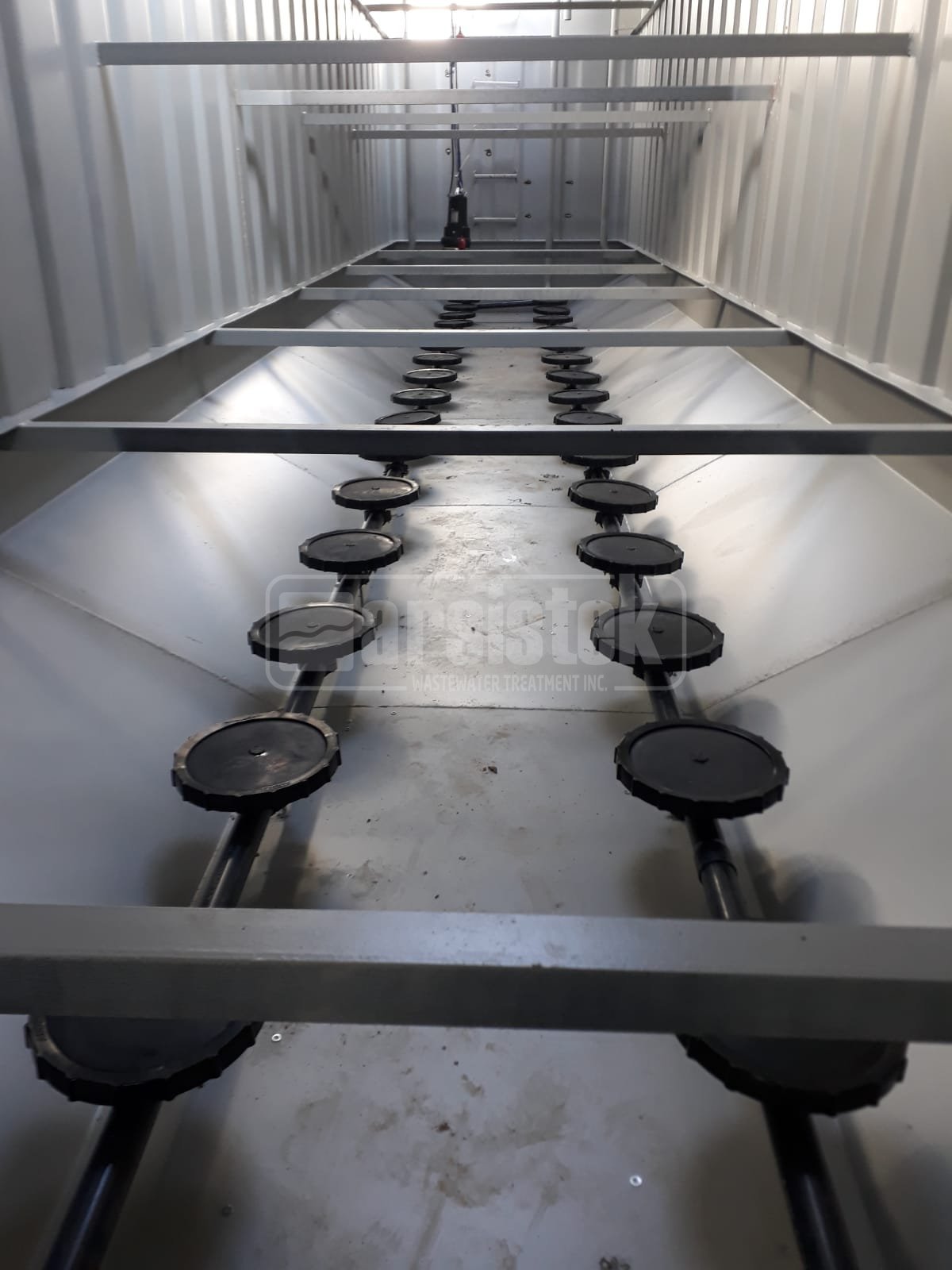
| Fine bubble diffusers | Efficiently distributes air |
| Pumps (transfer, dosing, sludge) | Transfer of wastewater/sludge |
| PLC + SCADA | Automatic control |
| Sensors (DO, pH, level) | Process monitoring |
| UV disinfection unit | Pathogen removal |
| UF membrane (if MBR) | Final solid-liquid separation |
| Control panel | Electric distribution + interface |
Effluent Quality
| Parameter | Classic / SBR | MBBR | MBR | SKKY Limit |
|---|---|---|---|---|
| KOİ (mg/L) | 50-100 | 40-80 | 15-30 | 125-160 |
| BOİ5 (mg/L) | 15-30 | 10-20 | < 5 | 25-40 |
| AKM (mg/L) | 20-40 | 15-30 | < 1 | 35-60 |
| NH4-N (mg/L) | 2-8 | 1-5 | < 1 | 5 |
| E.coli (CFU/100mL) | Post-UV < 100 | Post-UV < 100 | < 10 | 100-1000 |
Package Treatment vs Classic Site Construction Facility
| Criterion | Package System | Classic Concrete Construction |
|---|---|---|
| Installation time | 1-4 weeks | 6-18 months |
| Space requirement | Very little | Standard |
| Portability | Yes (especially container) | No |
| Suitable capacity range | 2-2,000 m3/day | 500+ m3/day |
| Investment cost (relative) | Low-medium | Medium-high |
| Lifespan | 15-25 years (steel tank) | 30-50 years (concrete) |
| Expandability | Modular (add parallel unit) | Difficult |
| Operational complexity | Low (automatic) | Medium |
Commissioning and Adaptation
After the package system arrives on site, the startup process begins:
- Mechanical installation (1-3 days): Tank is positioned, piping, electrical connection
- Hydraulic test (1 day): Leak testing with empty water + pump tests
- Seed sludge addition: 1-2 m3 of mature sludge from a nearby facility — starting biological population
- Start loading: Begin at half capacity, switch to full capacity when biomass is ready
- Biological adaptation (2-4 weeks): Bacteria proliferate according to temperature and wastewater composition
- Effluent quality tests: SKKY parameters are continuously monitored and adjusted until optimum point is reached
Common 5 Questions and Dangerous Mistakes
- Low loading: If the package plant receives little wastewater (e.g., a hotel off-season), the biomass will starve, and effluent quality will drop. Solution: recycle system for the lower limit.
- Grease leakage: If grease comes from the hotel/restaurant kitchen without pre-treatment — biological shock. Solution: grease separator is mandatory, periodic cleaning.
- Lack of administrative authority: An automatic plant "does not work by itself" — periodic control is necessary. Solution: remote monitoring + monthly service contract.
- Seasonal overload: Design capacity is exceeded during holiday/season peaks. Solution: balancing tank + peak factor in design.
- Neglecting UV lamp replacement: The lifespan of a UV lamp is 8,000-12,000 hours. An expired lamp does not disinfect. Solution: annual replacement plan.
Modern Trends
- Container package MBR: Full-scale facility inside a 20-40 ft container
- Remote monitoring: Live monitoring via mobile application, SMS alarm
- Solar-supported: Part of the blower energy from rooftop PV panel
- Water recovery module: Integrated UF+RO in package MBR — landscape irrigation water
- Modular expansion: If the hotel increases capacity, a second package unit can be commissioned in parallel
Conclusion
The package treatment system is a modern solution providing fast installation + compact space + automatic operation at small-medium flow points. The correct type selection (MBR/MBBR/SBR/activated sludge) depends on the characteristics of the wastewater, discharge limits, and recovery goals. It commissions 5-10 times faster than traditional concrete construction facilities in hotel, factory, OSB, small municipality, and construction site projects.
Related guides: MBR vs MBBR, SBR vs MBR vs Conventional, SKKY Discharge Limits. You can request a free preliminary study from our Arsistek engineering team for the right package system selection for your facility.
Atıksu arıtma uzmanı, çevre mühendisi. Endüstriyel su arıtma projelerinde 20+ yıl saha deneyimi.