





















Short answer: For low FOG (<50 mg/L), a simple grease trap is suitable; for medium levels (50-500 mg/L), DAF (Dissolved Air Flotation); for biologically degradable remaining parts, UASB or MBR is appropriate. In high FOG (1000+ mg/L) wastewater from slaughterhouses and dairy factories, the DAF → MBR series is the standard solution.
What is FOG, and Why is it Problematic?
FOG (Fats, Oils, Greases) are hydrophobic organic compounds found in wastewater in emulsion or free form. They are examined in three main categories:
- Animal fats: Pig, beef, fish oils — high melting point, low solubility
- Vegetable oils: Sunflower, corn, olive oil — high tendency to emulsify
- Mineral oils: Motor, hydraulic, cutting oils — biologically resistant, require advanced treatment
5 main problems caused by FOG:
- Sewage blockage — solidifies when cooled, forming a "sewer fatberg"
- Pump and equipment failure — adheres to emulsion change valves
- Inhibition in biological treatment — forms a film on the surface, reducing oxygen transfer
- Sludge bulking — filamentous bacteria explosion
- Exceeding discharge limits — Turkey's SKKY generally sets a limit of 30-50 mg/L
Method of Disposal According to FOG Concentration
| Concentration | Recommended Method | Typical Application |
|---|---|---|
| < 50 mg/L | Grease trap | Restaurant, small food business |
| 50-200 mg/L | API grease separator + biological | Hotel kitchen, cafeteria |
| 200-1000 mg/L | DAF + biological (aerobic/anaerobic) | Dairy factory, meat processing |
| 1000-5000 mg/L | DAF (chemical assisted) → MBR | Slaughterhouse, fish processing, palm oil |
| 5000+ mg/L | Pre-extraction + DAF + MBR/anaerobic | Oil refinery, biodiesel production |
1. Grease Trap (Grease Trap / API Separator)
The most basic method that separates phases by gravity. Since oil is lighter than water, it rises to the surface, water collects at the bottom, and sludge settles to the bottom. A three-compartment design is common.
Advantages: Low investment, simple operation, does not require electricity.
Disadvantages: Cannot retain emulsified oil, limited efficiency (40-70%), regular cleaning is required.
Typical HRT: 30-90 minutes. Mandatory at restaurant discharges (local municipality regulations).
2. DAF (Dissolved Air Flotation)
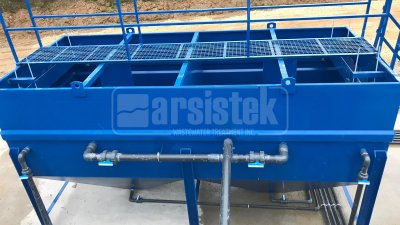
The industrial standard for FOG removal. Dissolved air is injected into the water under pressure (4-6 bar); when the pressure drops, micro-bubbles (30-50 µm) form, adhering to oil particles and carrying them to the surface. The foam on the surface is removed with a scraper.
3 main DAF configurations:
- Full flow DAF: All wastewater is pressurized — small facilities
- Partial flow DAF: Only the effluent part is pressurized — medium facilities
- Recirculating DAF: A portion of the treated water is recirculated and pressurized — large industrial (most common)
Performance improvement — chemical assistance:
- Coagulant: FeCl₃, alum — breaks the oil emulsion
- Flocculant: polyelectrolyte (cationic) — floc formation
- pH adjustment: pH in the range of 5-6 disrupts oil emulsion stability
Typical DAF efficiency: Mechanical (chemical-free) 60-80%; chemically assisted 85-98%.
3. Biological Methods
Biological degradation of FOG is possible; however, a multi-stage approach is required:
3.1 Aerobic (MBR, MBBR, Activated Sludge)
Since the contact of hydrophobic FOG with the microorganism surface is difficult, biological degradation is slow. Bacteria that produce lipase enzymes (Pseudomonas, Acinetobacter) first break down the oil into glycerol and fatty acids; then it is taken up by the cells and metabolized. The F/M ratio should be kept low, and SRT should be long.
The advantage of MBR in FOG removal: The membrane retains particulate FOG 100% as a physical barrier; high MLSS supports biological degradation. MBR is extremely effective in slaughterhouses and dairy factories.
3.2 Anaerobic (UASB, EGSB)
The most economical solution for high concentration FOG. Under anaerobic conditions, methanogenic bacteria convert fatty acids into methane → biogas production. Common in dairy, beverage, and palm oil wastewaters.
Typical anaerobic FOG efficiency: 70-90%. Limitation: excessive LCFA (long chain fatty acids) leads to inhibition — controlled feeding is required.
Sectoral Application Examples
Slaughterhouse Wastewater (High FOG + N + KOİ)
Typical composition: FOG 1,000-3,000 mg/L, KOİ 3,000-8,000 mg/L, NH₄-N 100-300 mg/L, AKM 1,500-3,000 mg/L.
Proposed process:
- Screening + grid (bones, feathers)
- Balancing tank (HRT 8-12 hours)
- DAF (chemical assisted, FeCl₃)
- Anaerobic (UASB) — biogas recovery
- MBR (nitrogen removal A2/O configuration)
- UV disinfection
Dairy and Dairy Products Factory
Typical composition: FOG 200-800 mg/L, KOİ 1,500-6,000 mg/L (whey is higher), AKM 500-2,000 mg/L. BOİ/KOİ > 0.7 — very suitable biologically.
Proposed process: Balancing → DAF → Anaerobic (UASB) → Aerobic (MBR) → optional RO (water recovery).
Restaurant and Cafeteria
Typical FOG 100-500 mg/L. Generally connected to the municipal sewer. Local requirement: grease trap — minimum 1500 L volume. Regular emptying (weekly or bi-weekly) prevents the risk of sewer blockage.
5 Practical Mistakes in FOG Removal
- Keeping the grease trap size small: If HRT <30 min, efficiency drops below 50%. Peak flow calculation is essential.
- Hot water discharge: Water above 50 °C keeps oil in dissolved form → passes through the separator. Cooling before wastewater is required.
- Neglecting surface foam: If float is not regularly skimmed in DAF, it re-enters the water. Scraper automation is critical.
- Insufficient chemical dosage: Mechanical DAF cannot retain emulsified oil; FeCl₃ or alum dosage provides a 20-30% efficiency increase.
- Directly feeding to biology: Feeding wastewater with 200+ mg/L FOG directly to the activated sludge pool = chronic bulking, loss of effluent quality. DAF is mandatory first.
4 Critical Parameters for Design
- Peak flow/average flow ratio: Restaurant 5-10×, slaughterhouse 2-3×, dairy factory 3-5×
- FOG/AKM ratio: If high, chemical DAF; if low, mechanical is sufficient
- Temperature: Effluent must be below 35 °C (oil solidification + separation)
- Float disposal: Annual tonnage of FOG retention should be calculated — either composting or biodiesel usage
Conclusion
FOG removal is the most frequently overlooked but critical pre-treatment step in wastewater treatment. The correct process selection should be made according to concentration, sector, and recovery goal. Restaurant-hotel: grease trap. Dairy-beverage: DAF + anaerobic. Slaughterhouse-fish: DAF (chemical) + MBR. In every case, FOG pre-treatment must be done before biological treatment.
Related guides: KOİ Removal, Nitrogen Removal, MBR vs MBBR. For FOG characterization and special process design for your facility, our Arsistek engineering team is at your service.
Atıksu arıtma uzmanı, çevre mühendisi. Endüstriyel su arıtma projelerinde 20+ yıl saha deneyimi.